
At FIFA 2026, the game the whole planet plays looked exactly like the Culturs community — people who live between and among worlds
For weeks the story on the pitch was one we’ve been telling for years. Lamine Yamal could have worn Morocco or Equatorial Guinea; he chose Spain. Morocco fielded a starting eleven born entirely outside Morocco. Cape Verde reached its first World Cup with a squad drawn from across Europe and the United States. Dual nationals. Foreign-born stars. Identity claimed rather than simply inherited.
That’s the Culturs community — TCKs, multi-ethnic people, children of immigrants, Military Brats, anyone forged in the space between cultures — standing at the center of the largest stage on Earth. For once, the people the world usually asks “but where are you really from?” weren’t at the margins of the story. They were the story beyond the game.
Moving through five countries as the tournament unfolded, I watched that same truth spill off the field and into the streets, the cafés and the living rooms — everywhere the game was watched.
In Mexico, where it all began, the tournament was already inescapable. Away from the capital the mood was easier, less frenzied, but the branding, the jerseys, the FIFA signage stretched across every plaza and storefront — a whole country leaning into a single shared event the way you feel weather change. The world’s game had arrived, and it belonged to no one flag in particular (but the Mexican pride was EV.ER.RY. THING!).
In the United States, the shift was obvious. For years Americans have crowned “world champions” in the NFL. This time I watched up close as people registered what the rest of the planet has always known — the electric, borderless pull of fútbol. A nation of immigrants discovering the world’s game. That recognition is the Culturs premise in miniature: the moment you realize the thing that makes you other is actually the thing that connects you to everyone.
In England, football’s oldest home, the through-line was heritage — the reality that talent raised in one country so often carries the colors of an ancestral one. It’s the diaspora arithmetic that built Morocco’s roster and half the tournament’s most compelling squads: children of one place, sons of another, refusing to choose because they don’t have to.
In France, the fever hit hardest for me before Spain. People planted themselves outside of the outdoor cafés into the streets, screens glowing over the tables, and stayed all night, unwilling to let the evening go. There’s poetry in France catching that fever, because no country better embodies what we write about. France is the tournament’s great diaspora engine — the nation that sends its sons to anchor other people’s teams. Aymeric Laporte and Robin Le Normand, both born in France, now form the spine of Spain. One flag, two homes, written straight into a squad sheet.
And in Madrid, the crescendo. The city didn’t watch the World Cup so much as inhabit it. Madrileños poured into the streets — whole families draped in flags, in fútbol gear, waving their banderas, leaning on car horns, screaming for every touch. Anywhere with a big screen and a window wide enough to see through became a gathering place, strangers pressed shoulder to shoulder on the sidewalk to watch a match on someone else’s television.
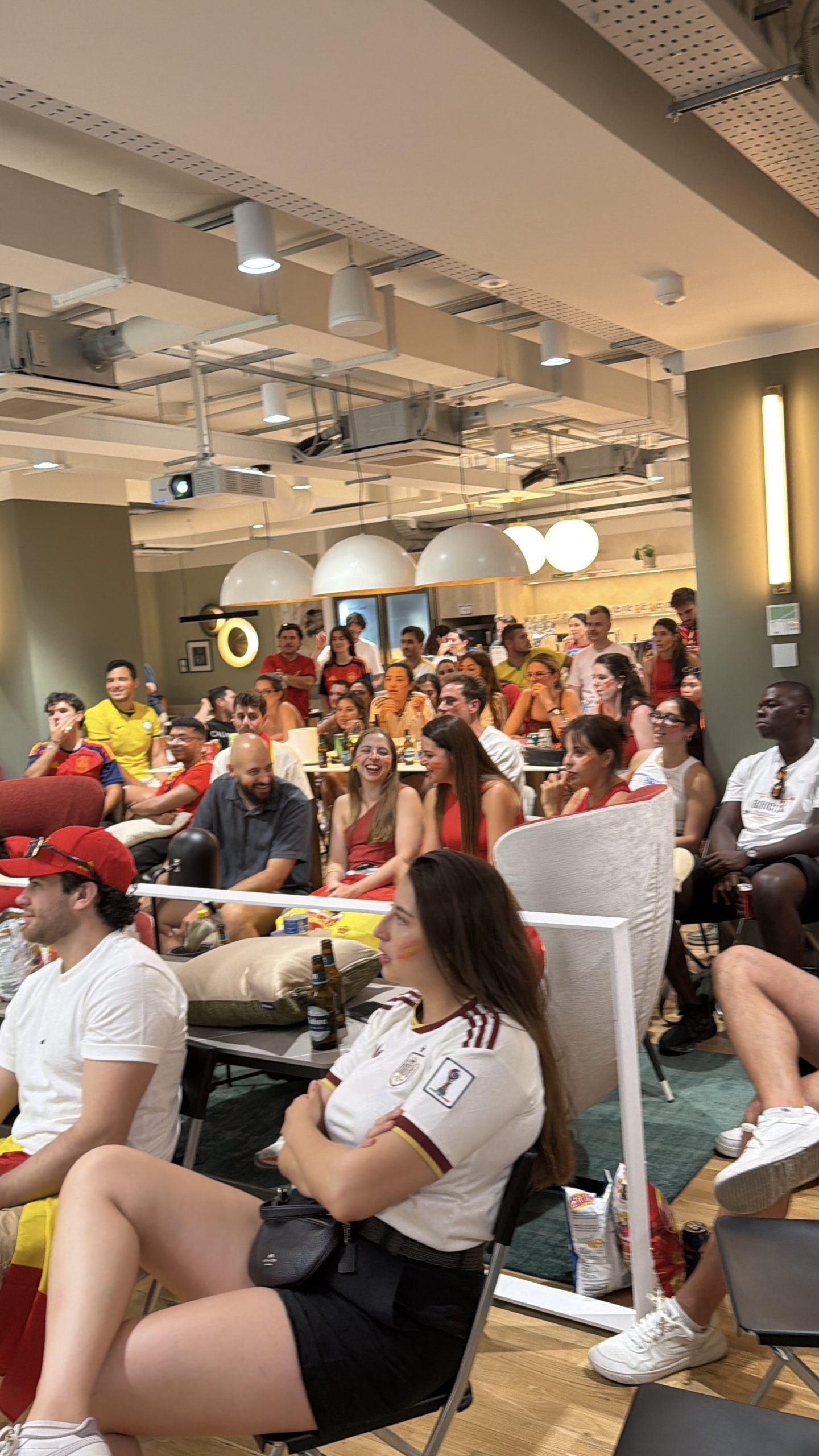
I watched the final — played an ocean away in the U.S. at New York/New Jersey field — inside a room across the world erupting with glee for Shakira and Justin Bieber, and wide-eyed at Madonna and BTS turning halftime into a spectacle of its own:
One was an office, the game on a wall-sized projection screen: two colleagues from Uzbekistan, two from the United States, my friends from India and Argentina who live in Spain and me. The other was home, with a Polish friend, a Portuguese friend and an Iranian colleague. Uzbekistan. The U.S. Poland. Iran. Portugal. India. Argentina. Spain. No shared passport in the room, and every one of us living and dying on the same ninety minutes. That is the Culturs community, sitting on couches in Madrid — proof that identity is fluid, that belonging is chosen, and that the world’s game is the one place we all agree to be from somewhere at once.
Spain won, 1–0 over Argentina, in extra time. The room erupted. Outside, Madrid detonated — horns, flags, voices climbing the buildings. The party ran past 3 a.m. and, I’m certain, never truly stopped. As my Polish friend put it, dry as ever: “I’m sure my Spanish colleagues will be unbearable tomorrow.”
They earned it.
We came into this tournament reporting on players who hold two homes under one flag. We leave it having seen the reverse everywhere it was played: a dozen flags in one small room, an entire planet home for the night in the same game. That’s the story FIFA 2026 will keep telling long after the confetti is swept away — and it’s the story Culturs tells every. single. day. The beautiful game didn’t erase our borders. For a few electric weeks, it simply made them beside the point.
Elleyne Aldine is Publisher of Culturs Magazine and CEO of Culturs Int’l Media Group, the print-first global media company for people living between and among cultures. She followed the 2026 World Cup across Mexico, the United States, England, France and Spain.