While India may be her “home,” culturally fluid actor and producer Priyanka Chopra Jonas has spent much of her career at the intersection of India and global storytelling.
The Bollywood scene is having a remarkable moment right now, with 1.4 billion people who continue to shade culture and business and entertainment.
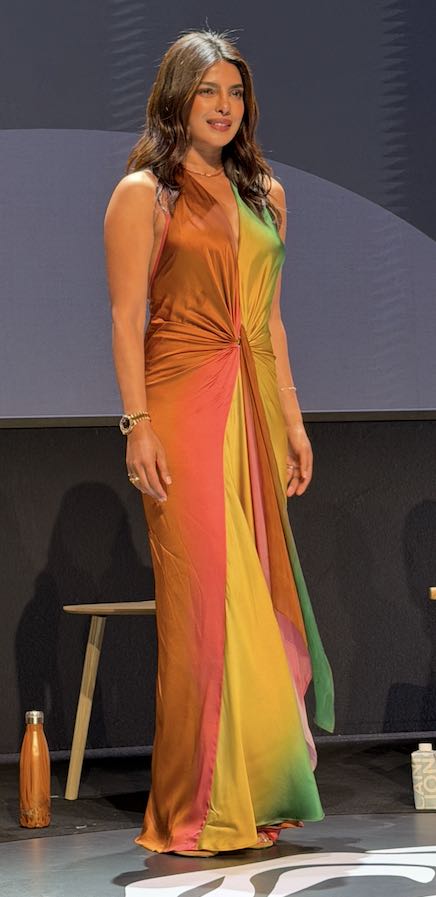
The film industry is moving toward a moment where stories aren’t as defined by where they’re made, whether it’s Hollywood, India or somewhere else, and more simply by whether they’re resonating globally, according to Chopra Jonas, who spoke at the 2026 Cannes Lions International Festival of Creativity.
“It’s a really exciting time to be in entertainment,” she says, “because I remember when I was doing Hindi films, Bollywood movies, I was always told that the reach of Indian cinema will never be as global as Hollywood, because we are not English-language, and everybody doesn’t understand whatever language our movies might be in — Hindi, Gujarati, whatever. And I used to always think about that a little bit. People don’t watch movies with subtitles in movie theaters, so it’s not gonna resonate.”
Streaming and the COVID pandemic helped change that, she adds.
“Honestly, people being at home and having access to entertainment from around the world. My mom loves Korean dramas. She would have never had access to those if it wasn’t for both of these factors,” Chopra Jonas says. “Or she’d watch like an Iranian movie or ‘Squid Games’ when it became the phenomenon that it did, or ‘Parasite’ when it won Best Picture [at the Academy Awards].
“Those are all incredible examples of movies and entertainment outside of the given English language, which we thought was universal, to now seeing success stories of so many movies that resonate with audiences around the world,” she continues. “And I think that it’s such a wonderful time for people who are creative, for creators, for artists, for anybody who has an idea and wants to tell that story.”
OPENING DOORS
That was one of the major factors that drew Chopra Jonas to start her own production company.
“I wanted new filmmakers … who have great ideas, but don’t have the ability to open doors that I may be able to,” she says. “Now, when I’m meeting filmmakers, directors, writers who pitch to me for projects, it’s so amazing to see people from such different backgrounds who have come into filmmaking. It used to be such a niche when I first started. It used to be [a] very specific job, if you want to get into filmmaking, you have to figure out what … department you want to be in. It was really hard to get into the industry.”
Nowadays, if an aspiring filmmaker has an idea, “shoot it,” she says.
“Put it on YouTube, and it can become [a box office hit like] ‘Obsession,’ the movie that just came out right now,” she adds.
It’s a “wonderful time” to be an entertainer and to be in the entertainment business, Chopra Jonas adds, because ideas are filmmakers’ “currency.'”
FEMALE PIRATES
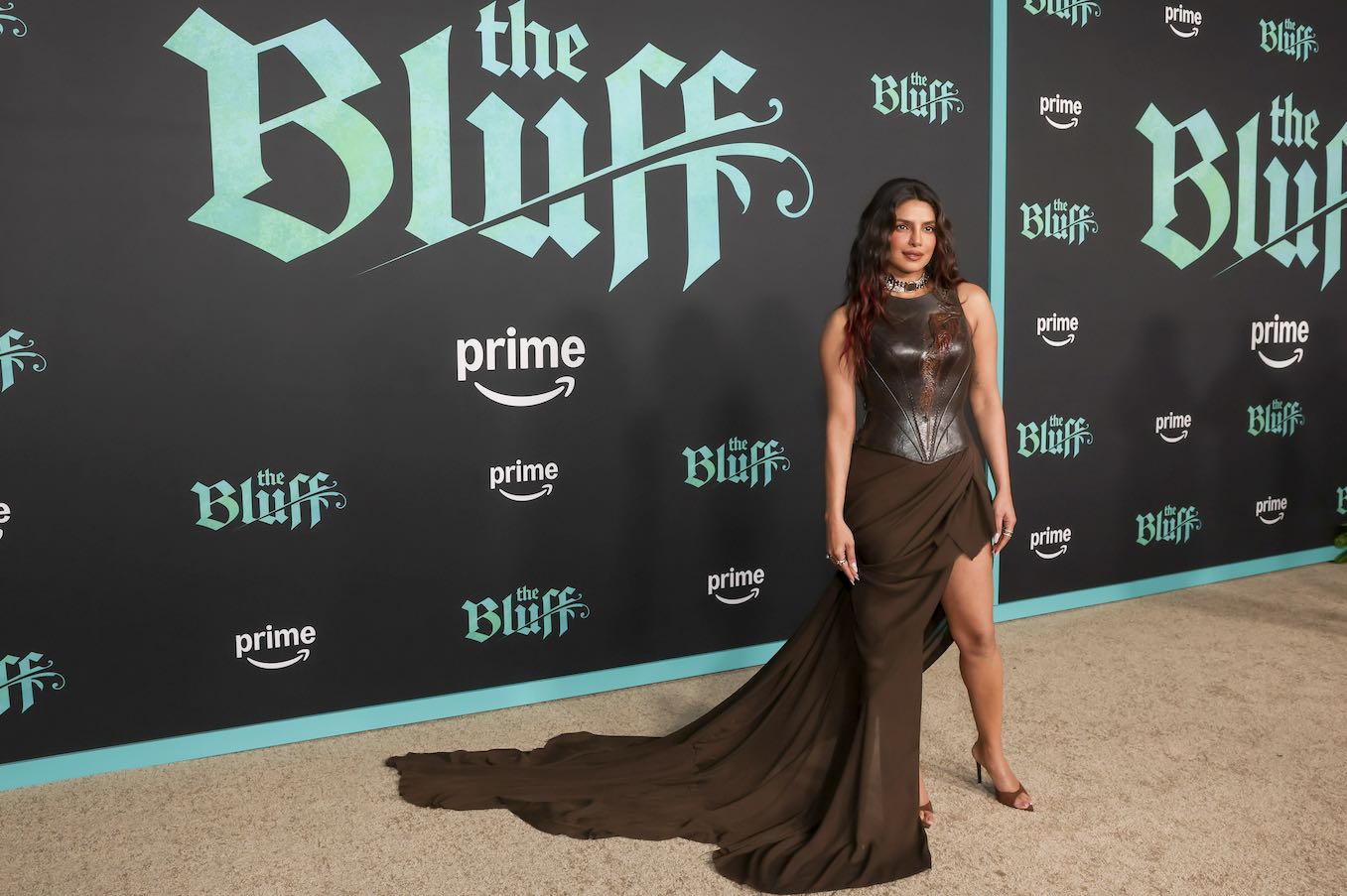
Chopra Jonas’ recent Amazon Prime hit movie “The Bluff” opened her eyes beyond the history of female pirates.
In that movie, Chopra Jonas plays Ercell “Bloody Mary” Bodden who thinks she had escaped her violent past as a pirate, finding peace in the Cayman Islands with her loving husband T.H. ( played by Ismael Cruz Cordova), their son Isaac (played by Vedanten Naidoo) and her sister-in-law Elizabeth (Safia Oakley-Green).
It’s so amazing to see people from such different backgrounds who have come into filmmaking.
But when her notorious former captain, Connor (Karl Urban), arrives seeking revenge, Ercell’s world is torn apart. Forced to confront the demons she’s tried to bury, Ercell is thrust back into a deadly game of secrets and survival.
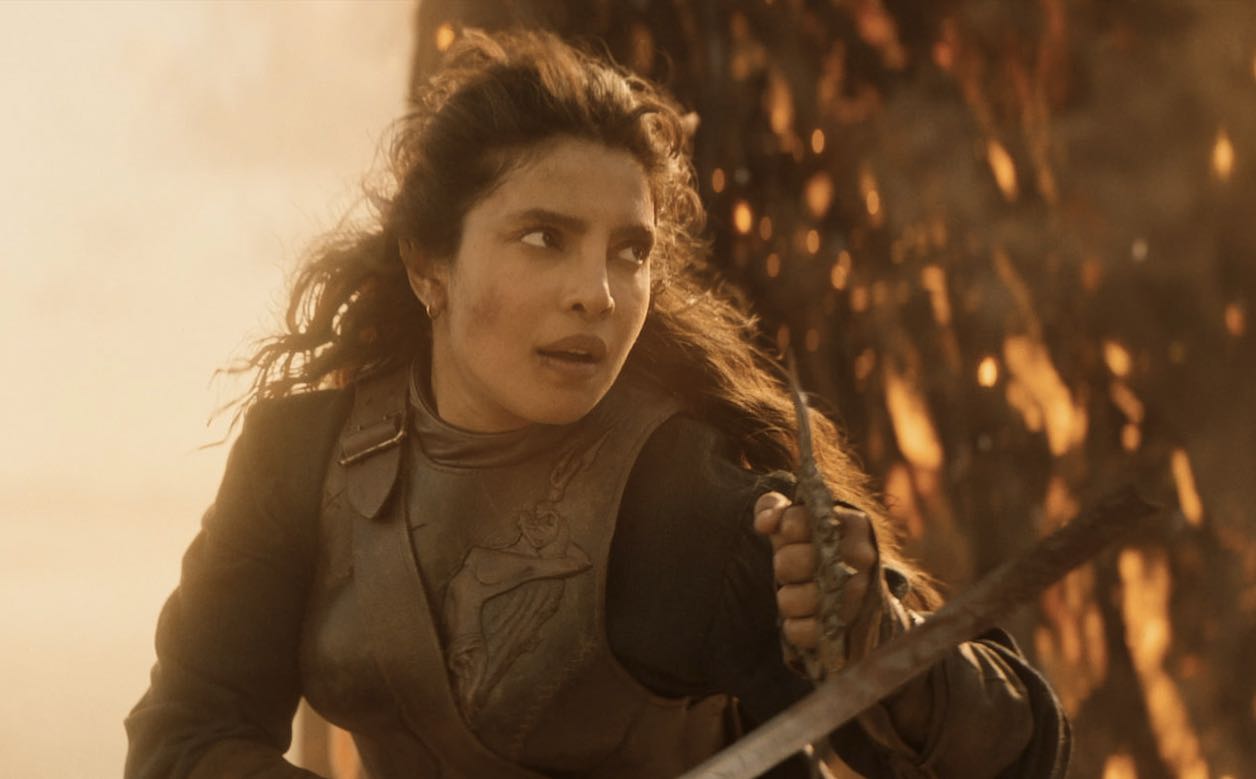
Armed with lethal swordsmanship, cunning traps, and a fierce will to protect those she loves, she wages a brutal war against Connor’s merciless crew. Ercell’s fight to save her family becomes a journey of redemption, as she reclaims her power and embraces the warrior she once was.
“I was really shocked at how many countries we were No. 1 in, because, first of all, it’s a female story,” according to Chopra Jonas. “Second of all, it was a female pirate, which most people didn’t know existed.

“Even when I first got the script, I did a deep dive into these women, and I was so amazed by such incredible stories of bravery,” she continues. “Can you imagine, in that time, being a woman who’s a pirate? So I was really excited about that. More than anything, it’s a story, it’s an action movie, it’s fun and all of that, but there were so many people that learned about what happened during that time with piracy, pirate culture, with indentured servitude that came from colonization, which was a big part of India, India’s history, where people were just taken with the promise of better jobs, and dropped into different parts of the world.”
While doing research for the film, Chopra Jonas met many people “who have no idea what happened four generations before them, or where their families come from, because somebody was taken and dropped in the Caribbean Islands, or Fiji, or somewhere … so that was very interesting to me: The information that a lot of people took out of it and still continued to talk to me, and I find that that was something that I loved as a producer. I just didn’t expect that to resonate as much as it did.”
REINVENTING ONESELF
In her autobiography “Unfinished,” Chopra Jonas writes about a piece of advice her father gave her: “Be like water, find the best situation, wherever you are, and make it work.”
That advice has spurred Chopra Jonas to reinvent herself as often as possible.
To that end, “I literally feel like I’m at the precipice of kind of trying to figure out what my next decade looks like,” she says.
Life has changed “tremendously” since she got married to singer and actor Nick Jonas, and now that they have a culturally fluid daughter, “your priorities really change, and I don’t just pack my bags and go off for a movie anymore. I don’t do five films a year. I don’t travel the way I used to. I’m really, really selective about the time that I spend and who I spend it with.”
In her English-language career, Priyanka Jonas says she really hasn’t had the variety and the reach she enjoyed in her Hindi-language career, where she worked with the best Indian filmmakers and actors, telling “amazing stories” and doing “a variety of genres.”
Whereas in Hollywood, in her English-language work, “I haven’t really done it as much,” she says.
“So [for] my next reinvention, I really want to figure out how to, in my English-language work, kind of bring that kind of variety to my characters that I have been able to do in India,” she says.
I literally feel like I’m at the precipice of kind of trying to figure out what my next decade looks like.
On top of that, she’s also navigating the “working mom life.”
“I have so much more respect for my mother [who was a doctor in India] now, now that I’m a working mom,” Priyanka Jonas says. “I’m my own boss. I can make my own time. My mom couldn’t, and my grandmother was such a big part of my childhood, because my mother and my dad both … were posted in different places. They were both working.”
When it comes to reinvention, “the quick answer is, I’m trying to navigate just, like everyone, what life is like as a working parent now, and how I can level up, again, with the variety and the genre of work that I do in my acting career,” she says.
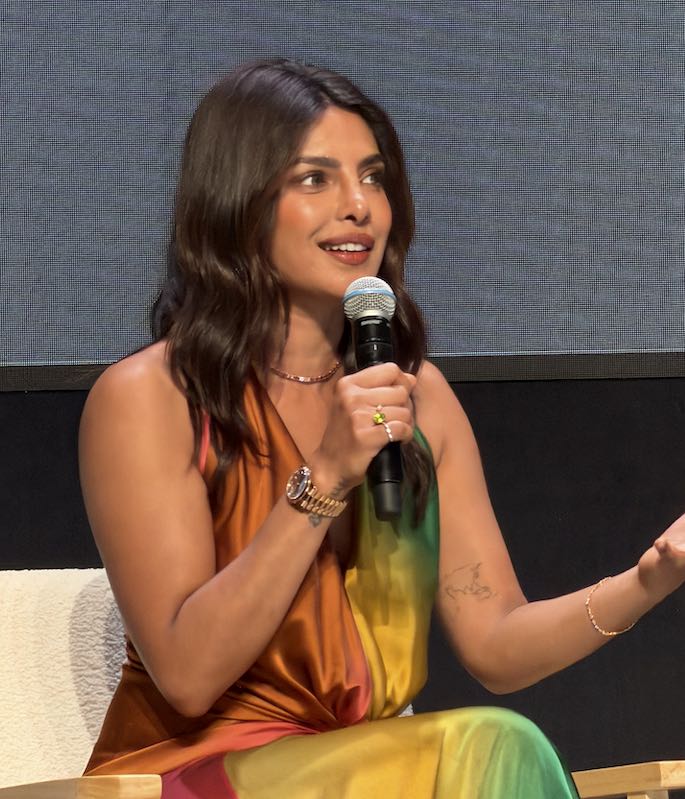
CONFIDENCE
In her autobiography, Chopra Jonas also writes she learned from her parents that “confidence isn’t a permanent state of being. It’s something that you have to work to maintain.”
“Confidence, I always say, it’s like going to the gym,” according to Chopra Jonas. “You want the right physique for the right body? You have to work on it. It’s like being a musician: You want to sing or play an instrument, you have to practice. So, confidence is sort of a practice and it’s a choice that you have to make.”
Of course, that confidence isn’t with you all the time, she adds.
“You will be nervous doing the most mundane things sometimes, and the biggest things don’t make you nervous, but when you feel that feeling, you have to be able to access the confidence in your backpack, the imaginary backpack I always carry with all my tools that I need,” she says.
Chopra Jonas always tries to tell young people that “you can’t fake confidence.”
“I used to think that ‘fake it until you make it’ was what I did. But eventually I realized that it really wasn’t,” she says.
Every time she walked into a room, Chopra Jonas would remind herself of what she brings to the table.
“My first audition in Hollywood when I came in, I hadn’t done an audition in about 15 years because I had been working in film in India for a really long time,” she says. “So, I remember walking into the room and seeing, like, 12 girls, none of them Indian, all of them, like, sitting on chairs, and I was frozen. I was like, I’m never gonna be able to do this.”
She remembers walking into a bathroom — almost as if it were a scene in a movie — and looking into the mirror.
“Thankfully, I was alone, looked at the mirror, and I reminded myself that I have done — now, I’ve done about 85 movies, but at that time, I’d done about like 50, 60 films,” she says. “I reminded myself that I know my craft. I know my tool. it’s not just about knowing your lines. You have to walk into a room with the presence of your character. You have to know all the technical aspects of being in film, which is, you know, your mark, what every department is doing, the lighting, the camera, the lenses. I know that stuff. I have that information. My toolbox is full.”
With that reminder, she “walked into the room, nailed it, got the job,” Chopra Jonas says. “But it took me accessing my backpack of tools.”
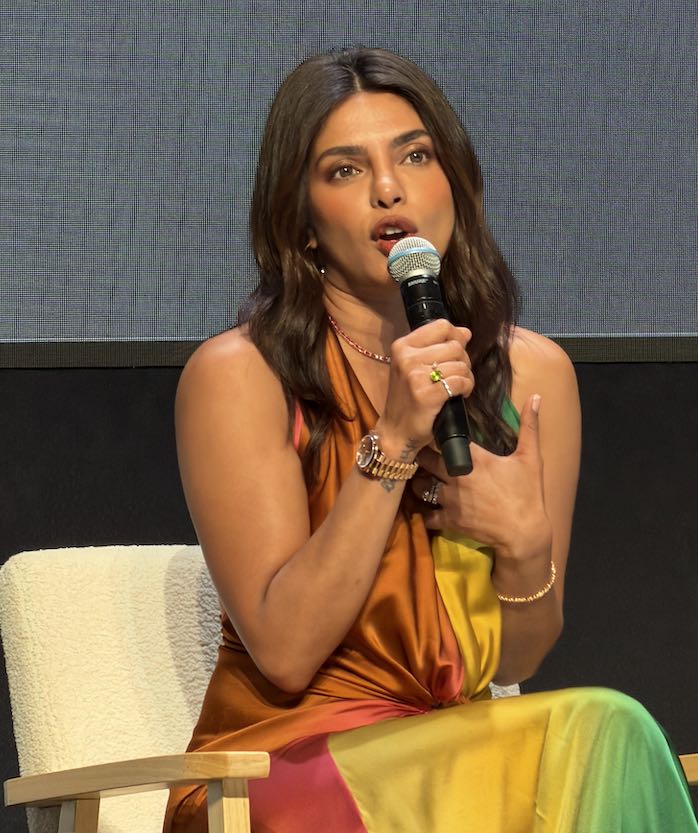
Chopra Jonas advises the Cannes Lions audience to “build your imaginary backpack of the tools that you need to give you the confidence of whatever in life you might want to achieve. But it’s practice, and if anybody says that they’re ‘naturally confident,’ I don’t think that’s true. I’ve seen a lot of people melt when they’re not confident.”
The most important thing for Chopra Jonas “is to not take your audience for granted, not take the love and attention that they give you for granted, [to] constantly evolve in every project that you take on.”
“You have to constantly, in my job, make sure that you’re listening to the audiences that are coming in to watch your movies,” she adds. “What are they interested in? Is the project that I’m taking on going to be something that’ll resonate with audiences that have liked my work? So, I ask that question of myself, with every single project that I take on, every association that I make, because I’ve always wanted to be authentic to myself, in everything I do, but keeping people’s attention is a really tough job, and you can only do it through evolution.”