

If you’re creative and culturally fluid — be it an Adult Third Culture Kid or Military BRAT or even just an expat — Oprah Winfrey has some life lessons that could apply to you.
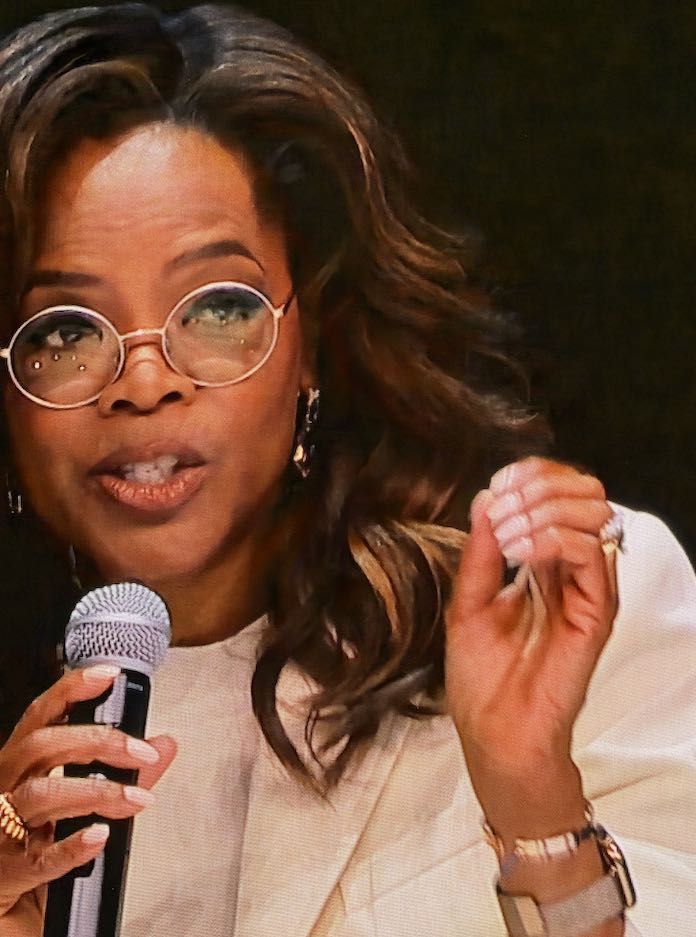
Speaking at the 2026 Cannes Lions International Festival of Creativity, Winfrey cites Gary Zukav’s book “The Seat of the Soul: An Inspiring Vision of Humanity’s Spiritual Destiny” as a major influence.
In that book, originally published in 1989, Zukav writes about what is real versus what isn’t real, and it also talks about having a multisensory personality, being able to see beyond the five senses as well as to know what’s real and meaningful beyond the five senses.
One of the most important lessons that Winfrey says she learned when she began “The Oprah Winfrey Show” in 1989 was that “none of us are separate. Every one of us is seeking the same thing — we’re just trying different avenues to get there.”
When your personality comes to serve the energy of your soul, that is “authentic empowerment,” Winfrey says. “And an authentic empowerment is the kind of empowerment that nobody can take away from you. So, no amount of views or subscriptions or sales or whatever — that will rise and fall in your lifetime. Sometimes you have good days, bad days, or you have successes and not successes.
“But the most important thing is to never lose sight of the real reason you have come to the planet Earth, the spectacular miracle that is actually your life,” she continues. “And you now get to use it in the role of a creator.”
ATTENTION AND INTENTION
Deepak Chopra’s “Law of Intention and Desire” posits:
“Inherent in every intention and desire is the mechanics for its fulfillment. Intention and desire in the field of pure potentiality have infinite organizing power.
“And when we introduce an intention in the fertile ground of pure potentiality, we put this infinite organizing power to work for us.
“This conscious change is brought about by the two qualities inherent in consciousness: attention and intention. Attention energizes, and intention transforms. The quality of intention on the object of attention will orchestrate an infinity of space-time events to bring about the outcome intended.”
For Winfrey, she took this law — which Zukav also adheres to — and applied it to working on “The Oprah Winfrey Show.”
“Once you realize that that is actually a truth, that it’s a physical law that’s operating in the universe, then you are more conscious of how you think about things, and more conscious of your intention, because what Zukav says and sees the soul is that your intention is one with the cause of the effect: You cannot separate them. You cannot have a cause without having an intention for wanting the cause,” she says.
Once she figured that out during her days on her talk show, Winfrey says she pulled all her producing team together “and I said, ‘Guys, we’re no longer gonna do any show unless I’m in alignment with your intention.’ And they’re like, ‘What are you talking about? We’re just trying to book some shows.'”
The most important thing is to never lose sight of the real reason you have come to the planet Earth, the spectacular miracle that is actually your life.
For those who are creators, she acknowledges that is really hard to do.
“You’re trying to do it every day and every day. It doesn’t matter if you had Tom Cruise yesterday — you gotta do something else the next day,” she says, adding that when sitting with a show guest, “I just have to have a thread of truth that I can hold onto so that when I sit in the seat, I am being true to myself, I’m not pretending, I’m not faking, and I am in alignment with what you’re trying to say.”
Consequently, Winfrey and her production staff would have meetings before every show to talk about what the intention is going to be, along with a meeting after every show, where she would ask: “Did we fulfill the intention? What is it we really want to get out of this?”
The first time Winfrey started using the principle of intention was for a show where the guest was a woman whose daughter had been murdered by her boyfriend.
The daughter was 16, the boyfriend was 18. Domestic violence in the United States, at the time, was one out of four girls. Nowadays, she notes, it’s one out of two who are in some kind of either physically or verbally violent relationship.
Months after the murder, the mother agreed to come on Winfrey’s show.
“I go into the green room. This is the first time I’m using this principle. I go into the green room and I ask the mom, I said, ‘Tell me, what is your intention in being here?’ She doesn’t know what I’m talking about. And she said, ‘I came because your producers asked me to come. I wasn’t even sure I was ready, but your producers talked to me’ — I had good producers, they could talk you into anything,” she says with a chuckle.
When Winfrey asked the guest why she wanted to come on the show, the guest said, “Because … everybody wants to talk about the murder. They want to talk about why didn’t I see it coming. They want to talk about how it happened. But my daughter had a life, and I’m here to talk about her life.”
“Well, I can do that,” Winfrey says. “I’ll make sure that happens. And this is what I’m gonna talk about: I’m gonna tell you that I’m gonna ask these questions. It’s gonna sound like I’m being a voyeur, or then I’m probing into your personal life, but it’s really so that everybody watching us feels the spirit and energy of your daughter. We tell the story in such a way that your daughter comes alive for them, so that they can share that story with their daughters. We’re going to save some daughters today.”
Did we fulfill the intention? What is it we really want to get out of this?
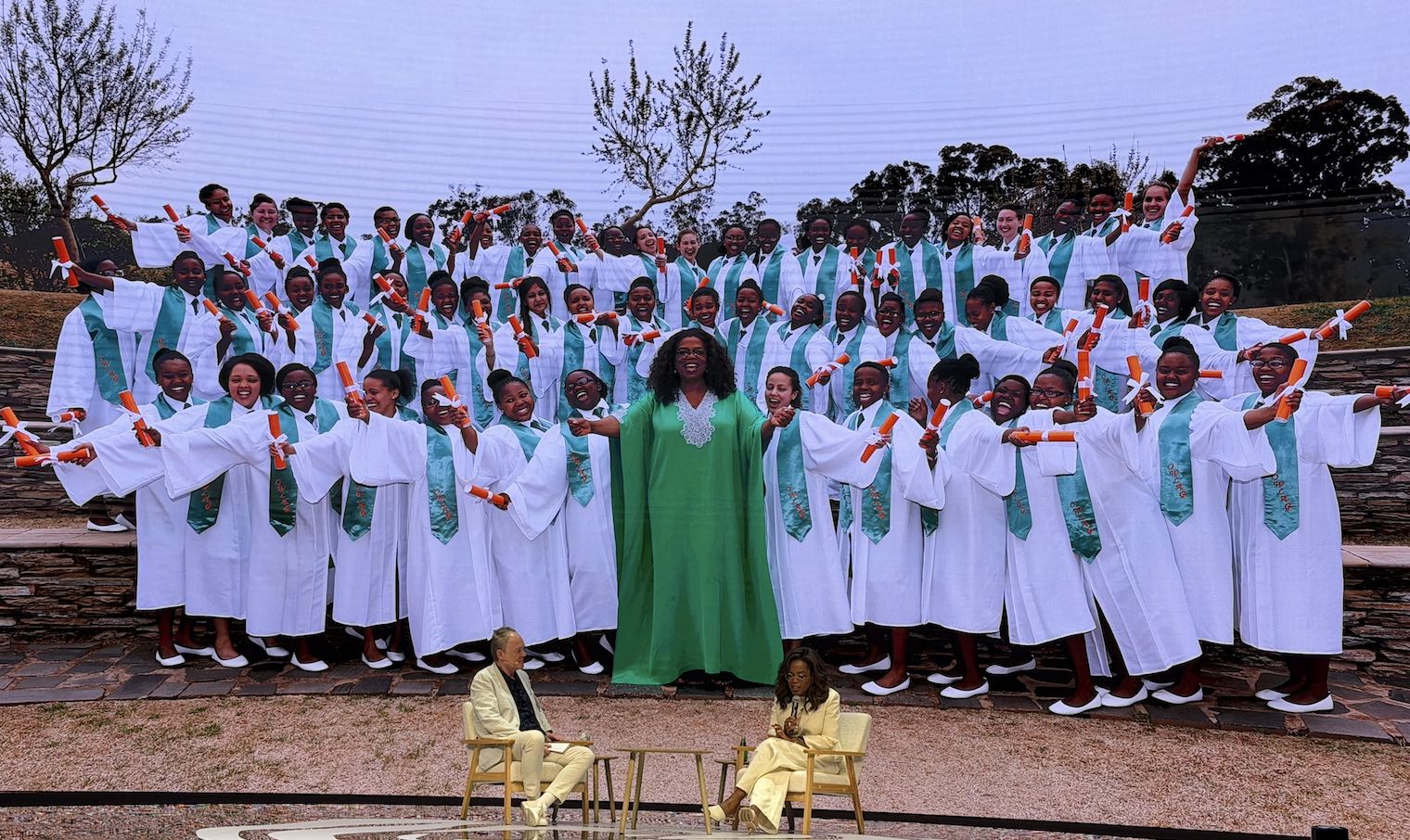
As her show rose in popularity, Winfrey realized it could be used as a force for good.
“I purposely said to the producers, ‘We’re not gonna let TV use us anymore. We’re gonna use it as a force for good, and every show that we do, in some form or another, is going to speak to where people are in their lives, and what the yearning and the search is for all of us. And those of you who watched us over the years, you know that that’s what we were trying to do,” she says.
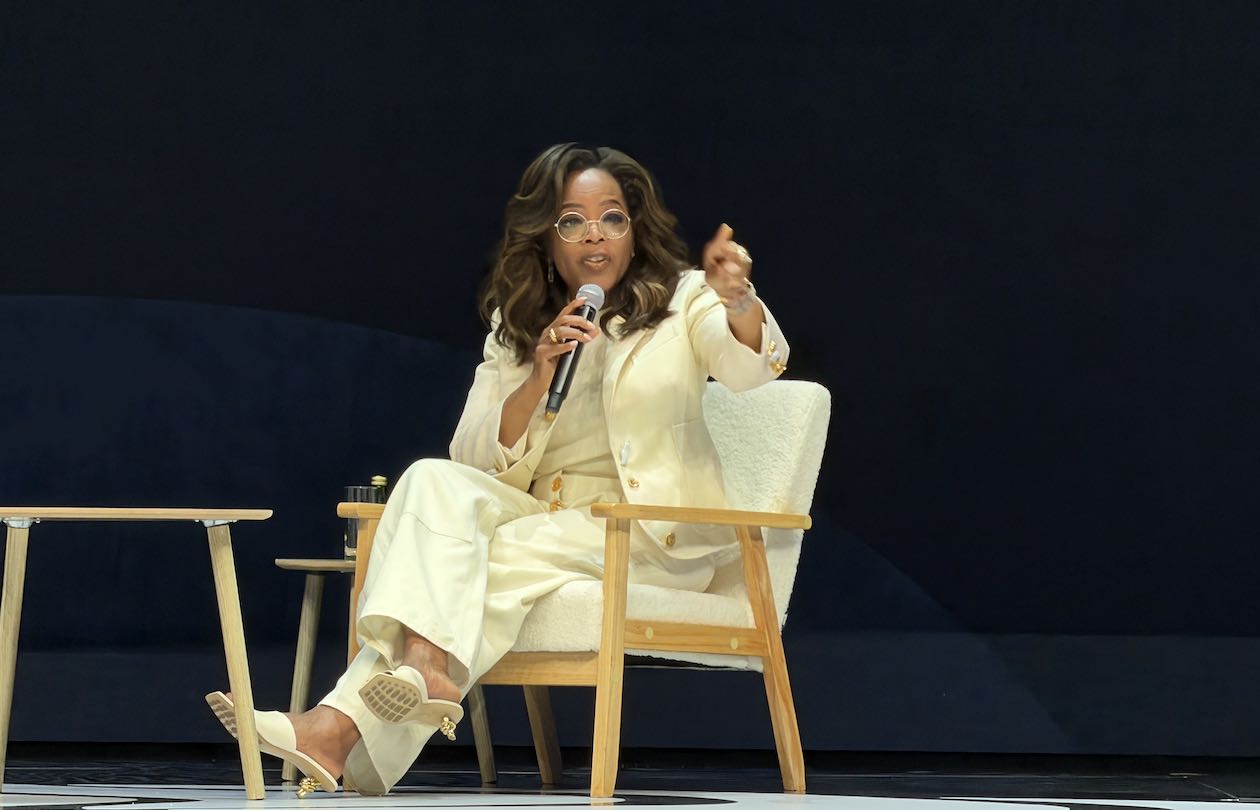
Winfrey believes “each of us was born to offer what it is you came with, and maybe your circle is just your family. Some people, your circle, is your community. Some people is your office. Every one of us has a platform in our life that you use as your circle of influence.”
“I just have been granted the great gift and the blessing of reaching millions of people,” she says. “And I understood from the beginning that it wasn’t about me — it was always about the people I was serving.”
THE POWER OF LISTENING
Another thing Winfrey has learned throughout her career is how to truly listen to people.
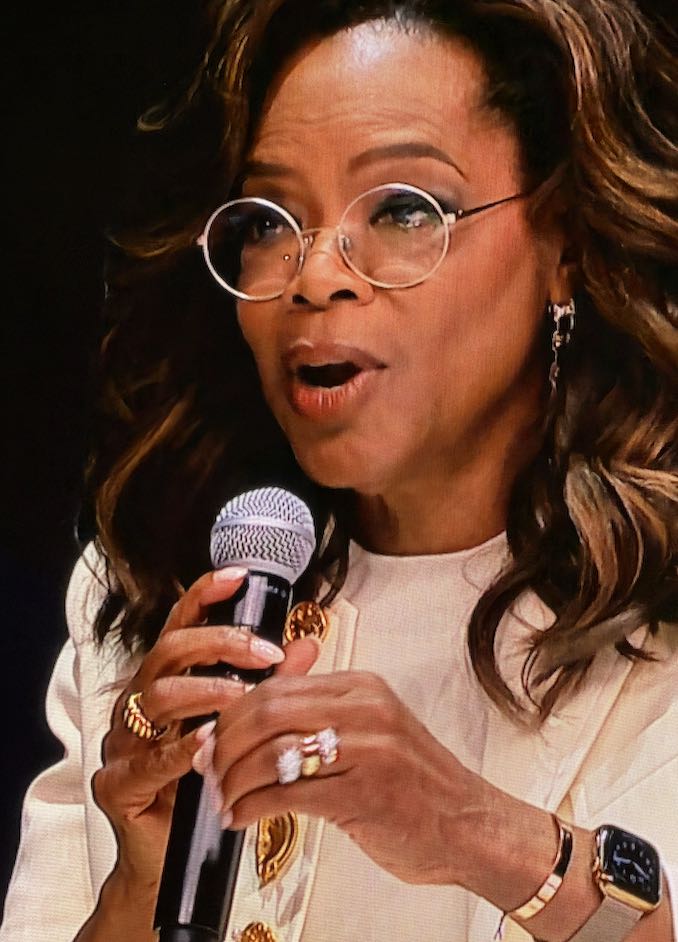
“What I learned is that the thread of our humanity, the thread of your yearning in life is the same as mine,” she says. “And we’re all looking for the same thing. That’s why when I meet you, we are on the same ground. Same level, no matter what ground you stand on. Because you want the fullest, highest expression of yourself as a human being, which is exactly what I want. That’s what we’re all striving for. That’s what all this creativity is about.”
No matter what you’re creative form of expression is, you don’t want that thing to rule you, Winfrey asserts.
“You want to let it fuel you, and you use it for the highest expression of yourself,” she says. “Because what I know we are all seeking, what I learned is that the thread of our humanity, the thread of your yearning in life is the same as mine. And we’re all looking for the same thing. That’s why when I meet you, we are on the same ground. Same level, no matter what ground you stand on, because you want the fullest highest expression of yourself as a human being, which is exactly what I want. That’s what we’re all striving for.
“That’s what all this creativity is about: How do I reach the fullest, purest, truest, highest expression of my creativity as a human being on the planet?” she continues. “And so, because we’re all seeking the same things and taking different paths to that, I understand it. And I also understand that the thread that runs through everybody is you want to know that you matter.”
Consequently, after every show, in one form or another, Winfrey says guests — regardless of their station in life, be it former U.S. President (and Adult Third Culture Kid) Barack Obama or singer Beyoncé — would always ask her, “Is that OK? Is that OK? How did I do?”
That led Winfrey to understand that “Am I OK?” is really the common denominator in the human experience.
What I learned is that the thread of our humanity, the thread of your yearning in life is the same as mine. And we’re all looking for the same thing.
“It’s happening in your life too, whether you know it or not,” she says. “Everybody you meet wants to know, ‘Am I OK?’ Every argument you’ve ever had, the person wants to know, ‘Do you hear me? Are you hearing me?’ You probably have said it yourself: ‘You’re not hearing me.'”
Consequently, Winfrey says a critical situation can be resolved by giving validation, putting mirror back on the other person.
Does it mean you have to agree with it? Not necessarily, she adds.
“It just says, ‘I hear you. Yeah. I hear what you’re trying to tell me is you want to do blank, blank, blank,'” she says. “I don’t want to do that, but I do hear that that’s what you want to do. And maybe there’s a way we can make that happen, but I hear you, I hear you. Because that’s where everybody is looking to see: How do I reach the fullest, purest, truest, highest expression of my creativity as a human being on the planet?
“Because we’re all seeking the same things and taking different paths to that, I understand it,” she continues. “And I also understand that the thread that runs through everybody is you want to know that you matter.”